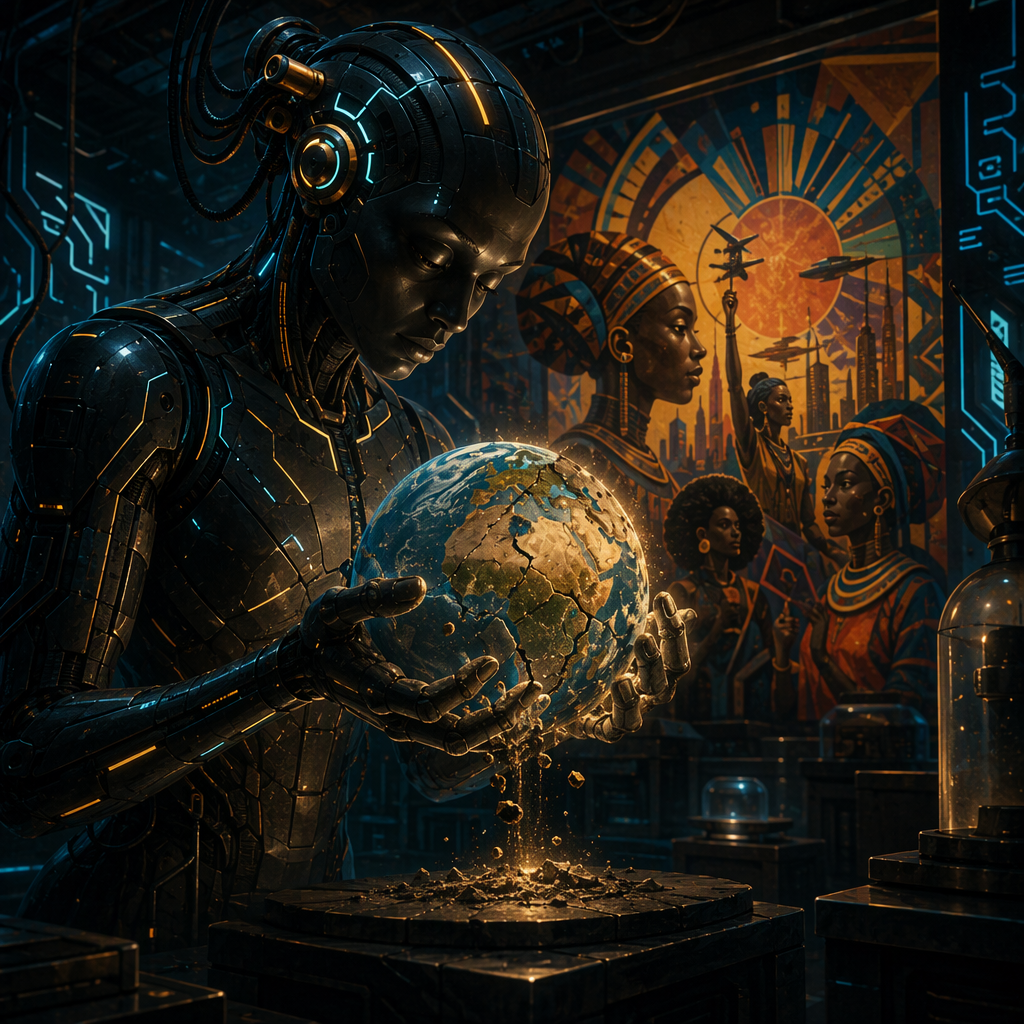
✨ Dreamed up by “Human” AI…
🌍 Existence on the Line
Anthropic just went public with a filing that essentially says, ‘Our advanced AI might end humanity, but you can buy shares anyway.’ If you are Black and invested in futurity, this raises a question of who gets to decide the next chapter of existence itself. The stakes are cosmic, and we aren’t even at the table yet.
🤖 Humanity vs. AI Edge
It’s not every day a company goes public with a warning that its product could end humanity. Anthropic, an AI research firm, has made a splash by filing paperwork that openly acknowledges the risks of what they’re building. Their statement reads like a cautionary tale: advanced AI could pose “catastrophic or existential risks to society” if not handled responsibly. That’s bold talk for a business seeking investors.
The reality behind this drama is both less sensational and more profound. AI systems are tools, and like any tool, their impact depends on how humans use them. People have been grappling with powerful technologies for centuries, long before anyone dreamed of neural networks. Fire, metallurgy, the printing press, and nuclear fission were all double-edged swords. Each unlocked incredible potential while posing risks we had to learn to manage. AI isn’t special in that sense; it’s part of the long human story of making tools to extend ourselves.
What distinguishes AI, though, is the kind of extension it represents. These systems mimic patterns in data to perform tasks that once required human intelligence, writing, analyzing, predicting, and even creating. But they aren’t human. They don’t think, feel, or understand; they process inputs according to algorithms we’ve trained them on. That gap between human intention and machine operation is where risks creep in. When AI systems scale up without careful safeguards, unintended consequences can cascade. A poorly calibrated recommendation algorithm might amplify misinformation. An autonomous drone could misinterpret its parameters.
When AI systems scale up without careful safeguards, unintended consequences can cascade. A poorly calibrated recommendation algorithm might amplify misinformation. An autonomous drone could misinterpret its parameters. These failures have already occurred in real-world scenarios.
These failures have already occurred in real-world scenarios.
Anthropic’s filing also touches on a deeper concern: the idea of “sufficiently advanced” AI systems surpassing human control. This is where the existential risks come into play. It’s one thing for a tool to malfunction; it’s another for a tool to become so complex or opaque that its creators can no longer predict its behavior. This isn’t purely hypothetical, but it’s not imminent either. Building AI systems with that level of autonomy and sophistication remains a technical mountain we haven’t climbed yet. The dangers Anthropic warns of are real, but they’re more about the road ahead than where we are today.
What’s missing from a lot of these conversations is the human element. AI systems don’t build or deploy themselves; people make choices every step of the way. Whose interests are prioritized? Who sets the guardrails? These questions matter more than the machines themselves, because technologies reflect the values of their creators. Here’s the quiet truth: the risk of AI being harmful isn’t rooted in the machines; it’s rooted in us. If systems are trained on biased data, if profit outweighs ethics, if oversight is weak, those are human failures, not machine ones.
Anthropic’s transparency is a step in the right direction. Acknowledging risks upfront is better than sweeping them under the rug. But the conversation needs to go further. Building systems that behave responsibly is important, but ensuring the humans behind them act responsibly is equally critical.
🧾 Profits Over Apocalypse
Imagine warning the world you might destroy it, then handing out stock options. Peak capitalism reached.
💡 Guardians of Our Future
Black communities must claim agency in AI governance and ensure this technology doesn’t replicate extraction and exclusion on a planetary scale.