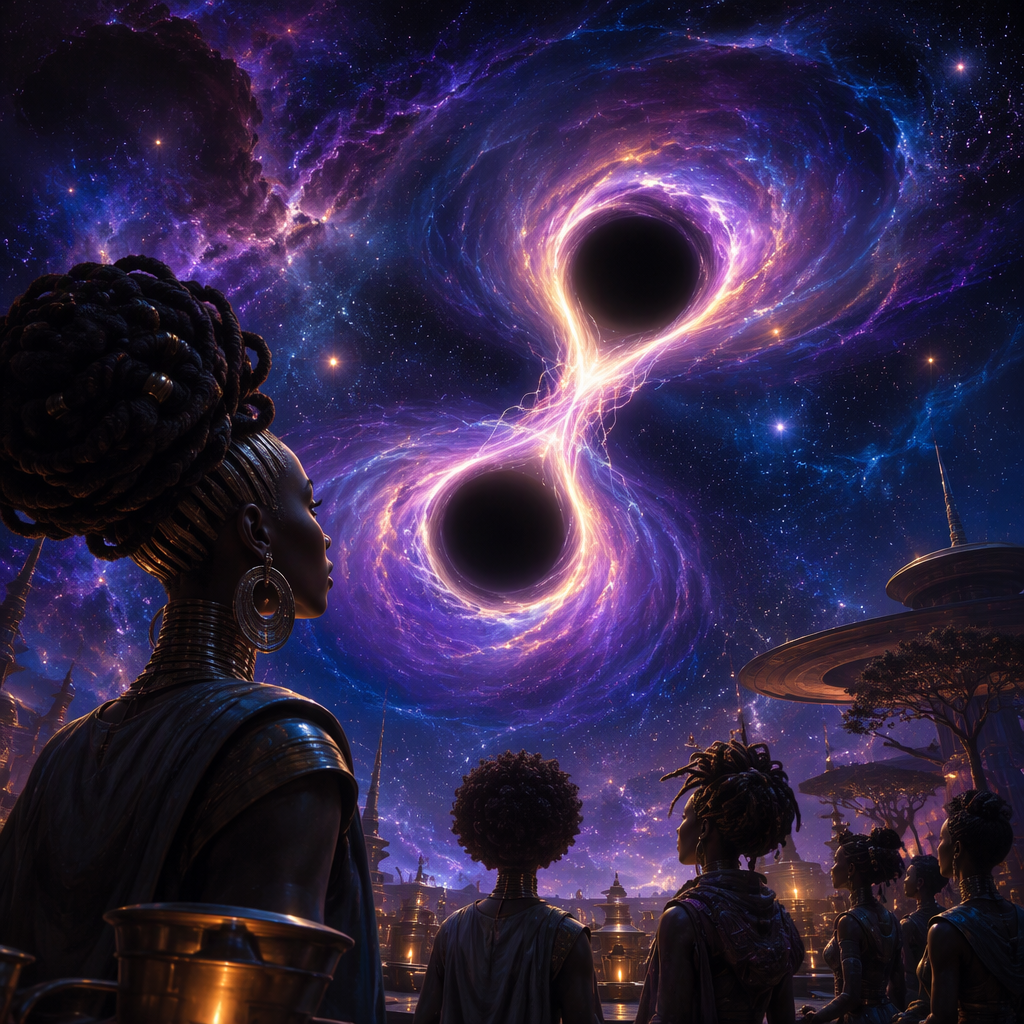
✨ Dreamed up by “Human” AI…
🌍 Cosmic Black Futures
Black holes dividing like cells? The universe stays on its ‘you thought you knew me’ flex. But the real cosmic loophole here is how Black scientists and theorists are still fighting for space in space, while discoveries like this remind us that Black futurity belongs everywhere gravity bends.
🌌 Cosmic Cell Division
Black holes already strain our imagination to the limit. These cosmic engines swallow everything, matter, light, information, into a singularity where our best physics breaks down. But now, a new proposal from physicists suggests they might not be as “singular” as we thought. Under the right circumstances, they could divide in two.
The idea centers on a phenomenon called “ultracold fission,” a hypothetical process where a spinning black hole could shed part of itself, splitting much like a dividing cell. When a black hole rotates fast enough, its event horizon (the boundary beyond which nothing escapes) can warp and stretch into complex shapes. Instead of the familiar sphere, a highly spinning black hole might look more like a dumbbell or even a pair of pants. And just as stretched soap bubbles can pinch off into separate droplets, the math hints that extreme gravitational conditions could allow a black hole to split into smaller, self-contained black holes.
The physics here is dense, but it hinges on a loophole in general relativity. Einstein’s equations describe how black holes form, interact, and grow, but they don’t strictly forbid them from dividing. The catch is that the conditions for this to happen would be extraordinary, requiring precise balances of spin, mass, and energy. Think of it as a cosmic high-wire act, where the slightest wobble would collapse the system back into a single black hole.
To understand why this matters, you have to think about how black holes grow in the first place. Normally, they merge and consume: stars, gas, other black holes. They’re one-way machines, always adding mass. But if black holes can also split, that flips the script.
Think of it as a cosmic high-wire act, where the slightest wobble would collapse the system back into a single black hole.
It means the “life cycle” of black holes might be more dynamic and complex than we’ve imagined. It raises questions about entropy, information, and the ultimate fate of matter that falls into a black hole. It also opens a door to studying their interiors in ways we’ve never considered.
Physicists haven’t observed this splitting directly, and they may never see it in action. The idea comes from simulations and theoretical models, not telescopes. But it’s a reminder that the universe still hides surprises in places we thought we understood. The edge of a black hole, where spacetime bends into knots, is as much a frontier as the deep ocean or the human mind. What we find there will rewrite textbooks about astrophysics and the nature of reality.
If this theory holds, it could also provide new clues about how black holes behave in the very early universe. Some of the first black holes may have been small, chaotic, and prone to splitting. Over time, the ones that survived might have grown into the supermassive giants we see at the centers of galaxies. In a way, these ancient black holes would be less like cosmic vacuum cleaners and more like cosmic seeds, scattering pieces of themselves to shape the galaxies we now inhabit.
All of this might feel far removed from everyday life, but it’s another reminder of how much creativity is baked into the universe. Even at its most destructive, nature finds a way to experiment. In the lab, in the code, and in the cosmos, the work of science is to catch up.
🌌 Galaxy’s Split Screen
Turns out black holes might moonlight as cosmic mitosis machines, dividing themselves like cells, because even physics likes a plot twist.
🌌 Cosmic Rebirths Unveiled
Black holes splitting like cells speaks directly to the cosmic layer of Black futurity: creation, division, and regeneration as forces that defy old limits. If proven, this challenges imagination, expanding what Black scientists, thinkers, and dreamers can envision in systems where endless replication is power.