✨ Dreamed up by “Human” AI…
🌍 Biodiversity Eviction 🚪
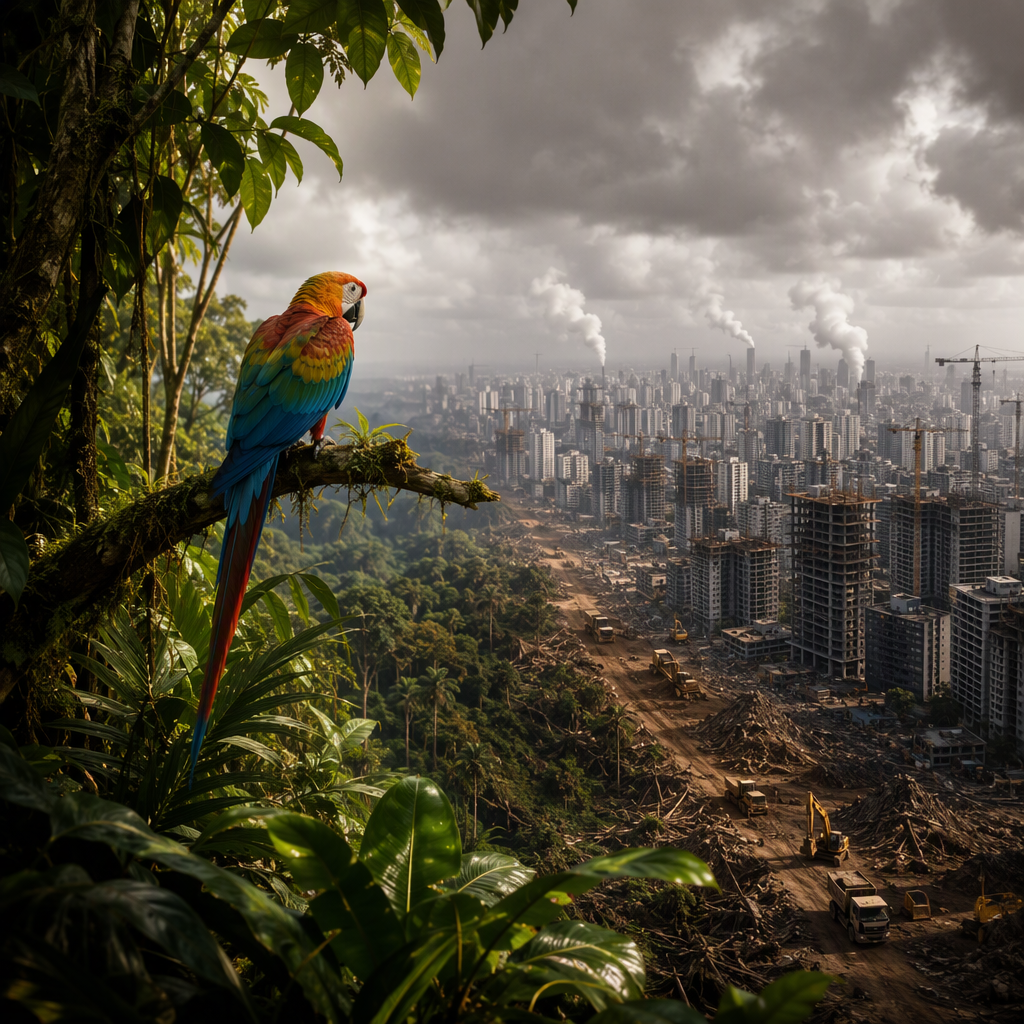
Urban sprawl is a biodiversity eviction notice. Tropical birds, some of the most stunning life forms on the planet, are being pushed out by concrete jungles that prioritize profit over ecosystems. When land becomes a commodity, life gets priced out, guess who profits from that extraction pipeline.
🌍 Tropics Under Siege
Tropical ecosystems are often celebrated as nature’s crown jewels, brimming with life forms so abundant that the numbers almost defy comprehension. The pattern is stark: as you move from the poles toward the equator, biodiversity surges. Scientists have been documenting this latitudinal diversity gradient for centuries, and fossil evidence shows that it’s no recent development. For millions of years, the tropics have been a hotbed of biological innovation, a wellspring for much of life’s variety on Earth.
But that brilliance, forged over geologic time, is colliding with a far more recent phenomenon: urban sprawl. A new study lays bare the scale of the disruption. Researchers tracked bird populations across tropical regions where human development has been carving deeper into natural landscapes. The results are grim. Species that once thrived in lush forests or open grasslands are either vanishing or struggling to adapt to fragmented habitats and concrete jungles.
Cities replace wild spaces, but even the surrounding areas, which might seem “green” from a satellite view, often end up degraded. Roads, farms, and subdivisions slice habitats into smaller, isolated patches, making it harder for species to find food, shelter, or mates. Some birds are generalists, they can eat a wide variety of foods or nest in different environments. These adaptable species sometimes manage to coexist with human expansion. But specialists, those that have evolved to thrive in precise ecological niches, face a much tougher climb. When their habitats disappear, so do they.
This isn’t the first time human activity has altered the natural balance. Civilizations have reshaped ecosystems for millennia, clearing land for agriculture, building roads and cities, and extracting resources. What makes today’s urban sprawl particularly concerning is its sheer speed and scale.
Cities replace wild spaces, but even the surrounding areas, which might seem “green” from a satellite view, often end up degraded. Roads, farms, and subdivisions slice habitats into smaller, isolated patches, making it harder for species to find food, shelter, or mates.
Tropical regions are home to some of the fastest-growing cities on the planet, driven by population booms and economic shifts. What took millennia to evolve is being undone in decades.
Not all is lost. There are practical ways to limit the damage, though they require foresight and commitment. Urban planners, architects, and conservationists have been experimenting with approaches that integrate biodiversity into the built environment. Green corridors, essentially wildlife highways that link fragmented habitats, can help animals move freely across urbanized landscapes. Protecting large, contiguous stretches of land and designing cities with nature in mind can also make a difference. A park can function as a lifeline for local species.
In a way, the crisis reminds us how connected we are to the ecosystems around us. Birds play key roles in pollination, seed dispersal, and pest control, services that underpin the health of entire ecosystems, not to mention agriculture. Losing them weakens the web of life we depend on.
If there’s a broader lesson here, it’s that the natural world doesn’t exist in isolation from human activity. We’re part of the system, shaping it as much as it shapes us. The challenge is finding a balance where both can thrive. Left unchecked, urban sprawl in the tropics could erode one of Earth’s richest sources of life, and with it, the lessons it holds about resilience, adaptation, and connection. The time to act is not some distant “eventually.” It’s now.
🌍 Feathers vs. Freeways
Tropical birds traded their vibrant treetop homes for a front-row seat to urban sprawl, and the view is tragic.
🌍 Biodiversity on the Brink
The destruction of tropical biodiversity represents an economic and ecological collapse waiting to happen, with frontline communities often bearing the brunt.