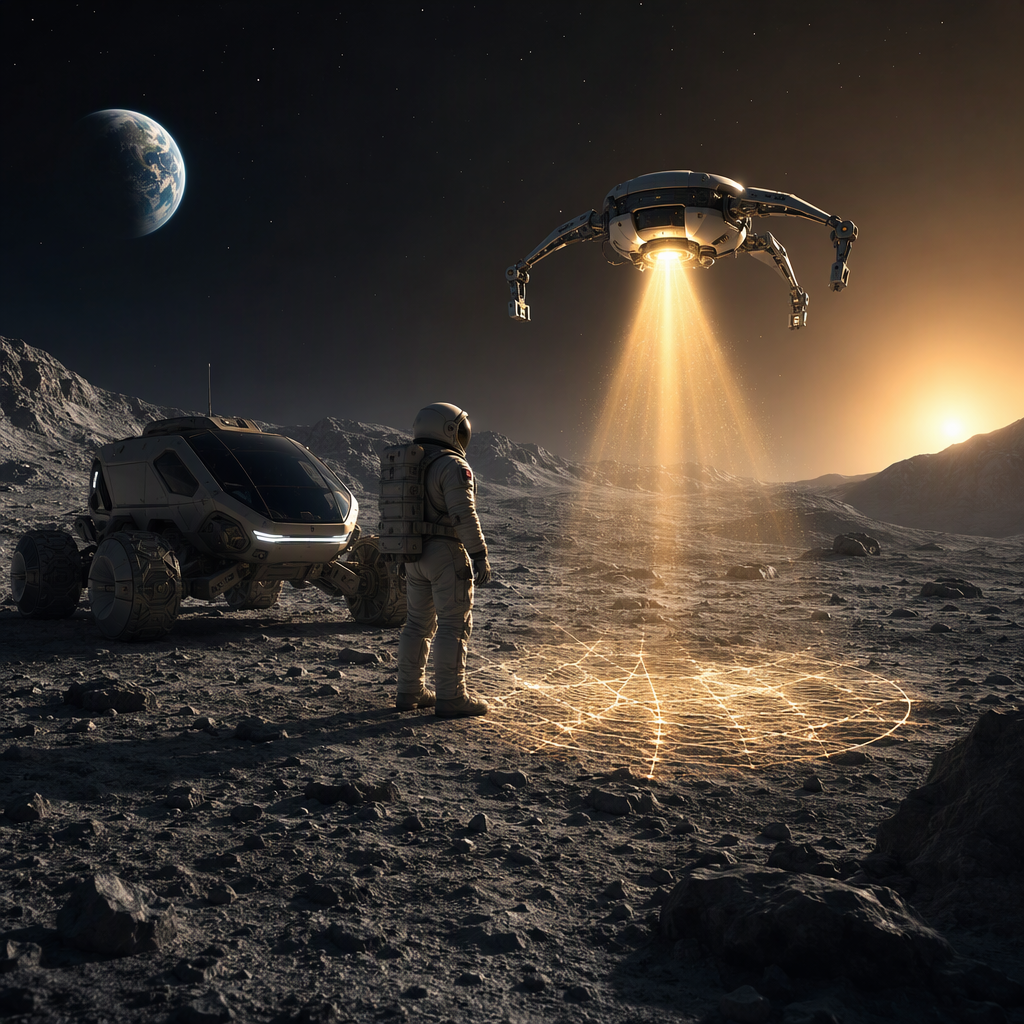
✨ Dreamed up by “Human” AI…
🚀 Whose Code, Whose Cosmos?
AI-powered moon landings sound exciting until you realize who owns the algorithms and who’s left out of the profit. Black scientists are still fighting for a seat at the table while Big Tech aims for the stars, literally. If the coding doesn’t include us, the future won’t either.
🤖 Gravity’s AI Gameplan
Imagine landing on a moon with gravity so weak that you could jump several meters high in a single bound. That’s what spacecraft and rovers face when they set down on smaller moons like Phobos, Deimos, or even larger asteroids. Gravity, the invisible hand that keeps us grounded on Earth, is barely there. Landing in such an environment is like trying to park on a steep hill coated in ice, with brakes that barely work. And that’s where artificial intelligence steps in.
On Earth or even the Moon, gravity helps stabilize a spacecraft during descent. It’s easier to predict how things will fall. But on smaller celestial bodies, weak gravity means landers are prone to bouncing or even floating off the surface entirely if they land too hard or at the wrong angle. The surface itself can be uneven, dusty, or riddled with craters and loose rocks. The combination of low gravity and unpredictable terrain demands precision that no human could manage in real time from millions of kilometers away.
Autonomous systems running on AI can solve these problems by making decisions faster than a human ever could. They use advanced algorithms to process data from cameras, radar, and other sensors in real time, mapping the terrain, calculating the craft’s speed, and adjusting the descent path on the fly. These systems can identify hazards like large rocks or steep slopes and steer toward safer landing zones. Machine learning models, trained on countless simulations, also help predict how a surface might behave on impact, whether it’s solid bedrock or something closer to quicksand.
They use advanced algorithms to process data from cameras, radar, and other sensors in real time, mapping the terrain, calculating the craft’s speed, and adjusting the descent path on the fly.
The Perseverance rover, now exploring Mars, already uses a form of this with its Terrain Relative Navigation system. During landing, it compared live images of the Martian surface to preloaded maps, adjusting its course autonomously to avoid danger zones. On low-gravity moons, similar technology would be even more critical. Add to that the challenge of dealing with dust clouds kicked up by the landing, particles that can obscure sensors or stick to lenses, and you start to see why AI is indispensable for these missions.
The history of landing on other worlds is a study in trial, error, and ingenuity. The Soviet Union’s Luna 9 was the first spacecraft to land softly on the Moon in 1966, using retro-rockets and airbags to cushion its fall. Fast forward to 2020, and you have missions like Hayabusa2 from Japan, which used detailed modeling to collect samples from the asteroid Ryugu, where gravity is so weak it’s measured in micro-gs. These missions laid the groundwork, but the complexity of future landings will require systems that can learn, adapt, and make split-second decisions on their own.
Why does this matter? Low-gravity moons and asteroids hold resources like water ice, metals, and rare minerals that could support human exploration or even fuel deep-space missions. To reach and work on these bodies, we’ll need landers and rovers that can handle environments no human pilot could navigate directly. AI is becoming the key that unlocks these distant, enigmatic worlds.
The next time we send a spacecraft to a strange, lumpy moon orbiting a gas giant, it will land, think, analyze, and adapt to the unknown. Quietly, without fanfare, it will do what humans have always done: figure out how to stay grounded, even when the ground barely pulls back.
🤖 Gravity’s Tech Guru
AI is finding ways to land on moons so gravity doesn’t have to do all the work, because apparently even space rocks need tech support.
💡 Claiming Space With AI
AI-enabled moon landings are engineering proof points that automation can extend human reach beyond Earth. For Black scientists and engineers pushing against exclusion in aerospace, this frontier is a chance to reclaim innovation spaces where our contributions have historically been erased. If we don’t shape the systems that will explore new worlds, we risk being left out of them entirely.